
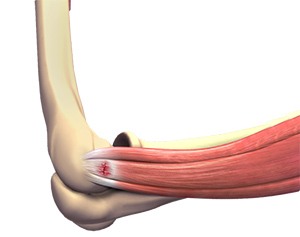
Tennis elbow is the common name for the elbow condition lateral epicondylitis. It is an overuse injury that causes inflammation of the tendons that attach to the bony prominence on the outside of the elbow. It is a painful condition occurring from repeated muscle contractions in the forearm that leads to inflammation and microtears in the tendons that attach to the lateral epicondyle. The lateral epicondyle is the bony prominence that is felt on the outside of the elbow and the condition is more common in sports individuals playing tennis.
Patients with tennis elbow experience certain symptoms and they include:
- Elbow pain that gradually worsens
- Pain to the outside of the elbow that radiates to the forearm and wrist with grasping objects
- Weak grip
- Painful grip
- Pain is exacerbated in the elbow when the wrist is bent back
Tennis Elbow is usually caused by overuse of the forearm muscles but may also be caused by direct trauma such as with a fall, car accident, or work injury.
Tennis elbow is commonly seen in tennis players, hence the name, especially when poor technique is used when hitting the ball with a backhand stroke. Other common causes include any activity that requires repetitive motion of the forearm such as:
- Painting
- Hammering
- Typing
- Raking
- Weaving
- Gardening
- Lifting heavy objects
- Playing musical instruments
Your physician will evaluate tennis elbow by,
- Medical History
- Physical Examination
- Diagnostic procedures such as X-rays
Your physician will recommend conservative treatment options to treat the tennis elbow symptoms. These may include:
- Limit use and rest the arm from activities that worsen symptoms.
- Splints or braces may be ordered to decrease stress on the injured tissues
- Ice packs to the elbow for swelling
- Avoid activities that tend to bring on the symptoms and increase stress on the tendons
- Anti-inflammatory medications and/or steroid injections to treat pain and swelling may be ordered.
- Occupational Therapy may be ordered for strengthening and stretching exercises to the forearm once your symptoms have decreased
- Pulsed Ultrasound may be utilized to increase blood flow and healing to the injured tendons.
If conservative treatment options fail to resolve the condition and symptoms persist for 6 -12 months, your surgeon may recommend you undergo a surgical procedure to treat Tennis Elbow called lateral epicondyle release surgery. Your surgeon will decide whether to perform your surgery in the traditional manner or endoscopically. Traditional surgery involves up to a 2" incision in the elbow area, whereas arthroscopic surgery involves one or two smaller incisions and the use of an arthroscope with a camera for viewing internal structures.
The television camera attached to the endoscope displays the image of the joint on a television screen, allowing the surgeon to look throughout the elbow joint at cartilage, ligaments, nerves and bone.
The benefits of endoscopic surgery compared to the alternative, open elbow surgery, include:
- Smaller incisions
- Minimal soft tissue trauma
- Less pain
- Faster healing time
- Lower infection rate
- Less scarring
- Earlier mobilization
- Usually performed as outpatient day surgery
Your surgeon will decide which options are best for you depending on your specific circumstances.
