
Toes are the digits in your foot and are associated with walking, providing balance, weight-bearing and other activities. A variety of toe deformities occur in children’s feet. They are as follows:
-
Hallux Valgus: Hallux valgus is a common toe deformity in which the child’s
great toe is shifted laterally and lies over the second toe. The first metatarsal bone is
deviated towards the medial side causing a prominence over the medial aspect of the
metatarsophalangeal (MTP) joint. A fluid filled sac (bursa) may form over this prominence
which may result in a painful bunion caused by continuous irritation and inflammation. Foot
pronation (flat feet) may sometimes be associated with this condition.
The factors that cause hallux valgus include structural foot anomaly that may or may not be hereditary and use of narrow shoes that curl or fold the toes. Children having hallux valgus may not have any symptoms most of the times and do not require any treatment. Your doctor may advise shoes that have good amount of space for the toes and no heels. If there is flat foot then a shoe insert may help to prevent its progression. Surgery may be recommended only in severe cases.
- Hammertoe: Hammertoe is a deformity in which there is downward bending of the middle joint of the toe or the proximal interphalangeal joint (PIP). Although it can affect the other toes, it most commonly affects the second toe. It may be present at birth or may result from wearing shoes that are too tight which forces the toe to bend forward. It causes no pain and does not require any specific treatment. Hammer toe can be treated by ensuring that your child wears well fitting shoes that has enough space for the toes to stretch.
- Mallet Toe: Mallet toe refers to the downward bending of the third joint or distal interphalangeal joint (DIP) giving it a mallet-like appearance. Corns or calluses may develop over the deformity as a result of constant friction against the footwear. Mallet toe can be inherited or may develop from wearing shoes that are too tight or high-heeled.
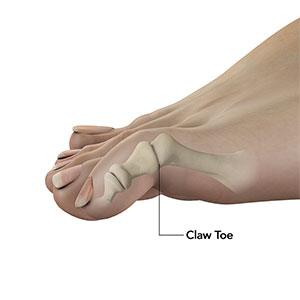
- Claw Toe: Claw toe is a rare deformity but occurs in association with cavus foot, Charcot-Marie-Tooth disease or myelomeningocele. It affects all the toe joints and results from hyperextension of the metatarsophalengeal (MTP joint or 1st joint) and flexion at the PIP (2nd joint), and DIP (3rd joint) joints. It results from altered structural anatomy and /or neurologic disorder that cause muscle imbalances.
- Curly Toe: Curly toes are present at birth and affect the third, fourth and
fifth toes of one or both the feet. It is caused by tightening of the tendon that runs below
the toe which results in pulling of the tip of the toe under the next toe towards the sole.
Your child may develop areas of hard skin on the sole of the foot and may have difficulty in
selecting suitable shoes that fit properly.
Generally, no treatment is needed if curly toes do not cause any symptoms but if the condition becomes severe and causes irritation, then surgery may be performed to release and transfer of toe flexor.
- Polydactyly: It is a condition in which there is an extra digit present in the feet. The great toe or the fifth toe is usually affected. It may occur in association with other congenital anomalies or as an isolated problem. If the extra digit does not cause any problem, it may be left alone without any treatment. Surgical excision of the extra digit will be done in cases where there is an extra little or big toe that is prominent causing difficulty in wearing shoes. Surgery is usually done after the age of 9-12 months.
- Syndactyly: Syndactyly is the presence of fused digits and may occur along with other congenital anomalies or as an isolated problem. It rarely causes any problems and does not need any treatment. The connection between two or more toes varies from a thin skin attachment to a bony attachment (synostosis) between the phalanges.
- Bunionette (Tailor Bunion): Bunionette is less common and occurs at the fifth MTP joint. When this occurs, the fluid sac over the lateral side of the fifth MTP joint becomes prominent and inflamed causing pain. Padding is done to relieve the discomfort. If this does not help, surgical correction will be needed.
